
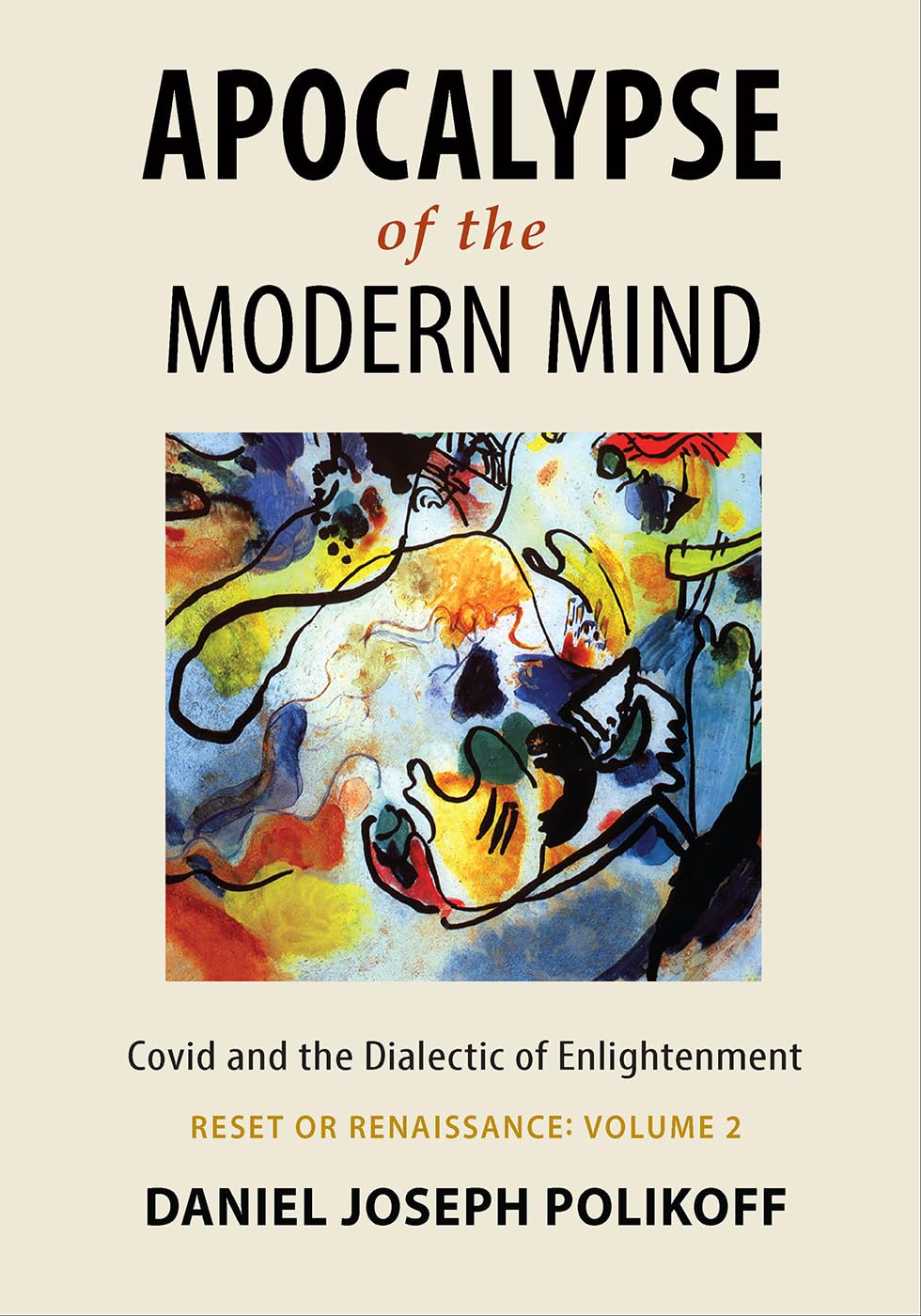



Apocalypse of the Modern Mind is the second volume of Daniel Polikoff’s groundbreaking Reset or Renaissance series. The first (An American Scholar’s Covid Chronicle) tells us what really happened during Covid. This compelling sequel tells us—not only how—but why.
The democratic impulse that emerged with such dramatic effect (first in America and later in Europe) grew out of a rich soil of ideas revolving around the most profound and far-reaching concerns: the status of divine and natural law and the relationship of the one to the other; the respective provinces of reason and of faith; the nature and destiny of humanity.
It is in reviewing and recollecting that rich intellectual history that we can gain insight into the principles underlying the philosophy of democracy and (more generally) the truly liberal impulse that engendered modernity. It is that order of comprehension, as well, that enables vision of the counterfeit side of that precious coin: the deformation of liberal and democratic ideals implicit in the nefarious “dialectic of enlightenment” and its frightening consequence: the technocratic authoritarianism so dramatically displayed in the Covid era.
Polikoff is concerned here not only with the dark shadows that creep in under the door of our enlightened modernity, but with radical solutions to the problems thus posed: solutions suggested by those bearers of a renewed Romantic or Transcendentalist idea of what enlightenment really means.
About the Author
Daniel Joseph Polikoff, PhD, is a poet, translator, and independent scholar. He received his PhD in Comparative Literature from Cornell University and his Diploma in Waldorf Education from Rudolf Steiner College. In addition to work in numerous literary journals and anthologies, he has published two collections of poetry (Dragon Ship and The Hands of Stars) as well as Parzival/Gawain: Two Plays, his edited translation of a dramatic version of the Grail legend. Dr. Polikoff has taught literature in Waldorf schools and shared his passion for Rilke in a wide variety of venues, including the Festival of Archetypal Psychology at Notre Dame (where the idea was born for his book In the Image of Orpheus); the San Francisco Jung Society; and seminars in literary circles. He has also taught at Sonoma State University, California Institute of Integral Studies (CIIS), and Pacifica Graduate Institute.



Reviews
There are no reviews yet