
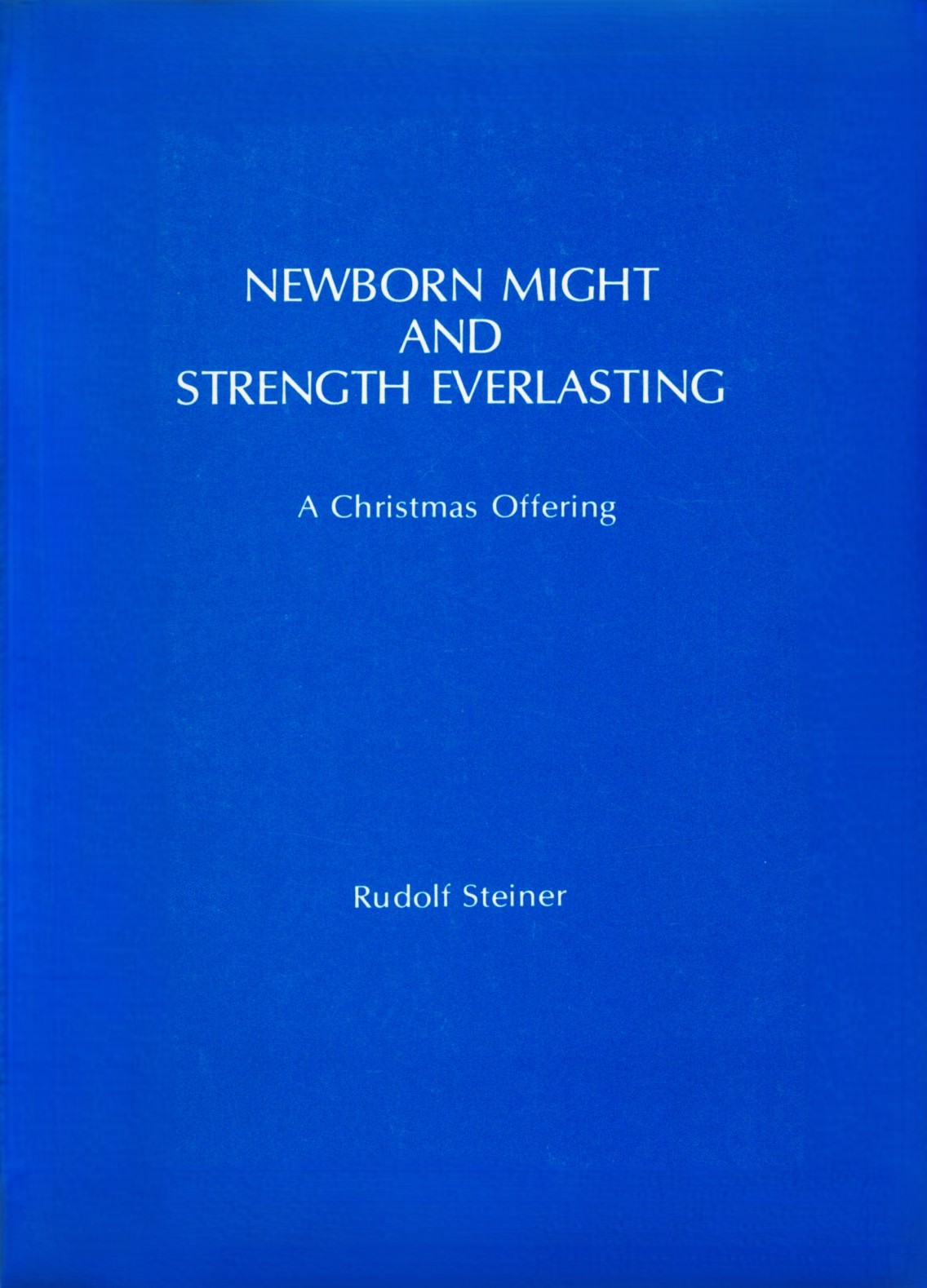


Newborn Might and Strength Everlasting: A Christmas Offering
Lecture was given in Berlin on December 23, 1913. (CW 150)
IT MIGHT SEEM as if our world conception, based on spiritual science, could impair that simple joy, so full of love, that filled many hundreds of hearts throughout the ages whenever one of the old plays, such as the one we have just seen, portraying the Heavenly Child and His earthly destiny was performed for them. It really seems as if that simple, loving joy could be impaired by our teachings concerning Jesus Christ that encompass such a wealth of things and that are apparently so complicated. Yet, we must strive to understand them in accordance with the impulses streaming through our world conception. Indeed, every heart and soul will be filled with joy because such a play can make us realize again how the souls of men, whether they had undergone a certain experience in spiritual life or had lived a simple country life, whether they came from large cities or the loneliest hamlets, felt themselves drawn to the Heavenly Child. In him they felt the strength that had once entered the evolution of mankind, and that had saved it from the spiritual death it otherwise, because of the eternal laws of the universe, could not have escaped. (Opening Paragraph)
INCLUDED: Foldout B/W Image of the Pisa, Campo Santo: The Triumph of Death (Purgatory)
About the Author
Rudolf Steiner (b. Rudolf Joseph Lorenz Steiner, 1861–1925) was born in the small village of Kraljevec, Austro-Hungarian Empire (now in Croatia), where he grew up. As a young man, he lived in Weimar and Berlin, where he became a well-published scientific, literary, and philosophical scholar, known especially for his work with Goethe’s scientific writings. At the beginning of the twentieth century, he began to develop his early philosophical principles into an approach to systematic research into psychological and spiritual phenomena. Formally beginning his spiritual teaching career under the auspices of the Theosophical Society, Steiner came to use the term Anthroposophy (and spiritual science) for his philosophy, spiritual research, and findings. The influence of Steiner’s multifaceted genius has led to innovative and holistic approaches in medicine, various therapies, philosophy, religious renewal, Waldorf education, education for special needs, threefold economics, biodynamic agriculture, Goethean science, architecture, and the arts of drama, speech, and eurythmy. In 1924, Rudolf Steiner founded the General Anthroposophical Society, which today has branches throughout the world. He died in Dornach, Switzerland.



Reviews
There are no reviews yet