
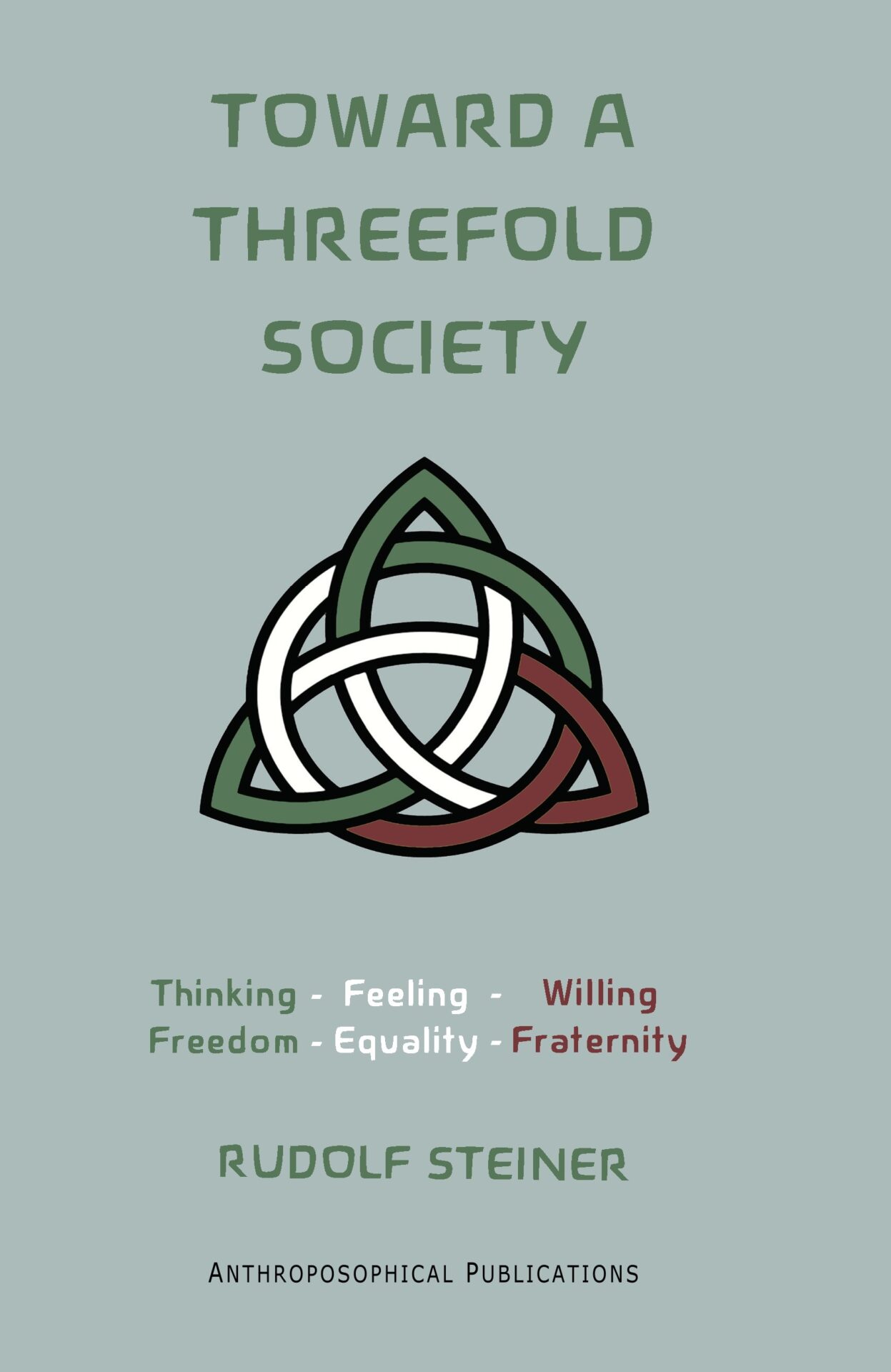


Toward a Threefold Society: Basic Issues of the Social Question
A reinvigorated translation by Frank Thomas Smith of Steiner’s “Basic Issues of the Social Question,” number 23 in the Bibliography of 1961. This work, written late in the life of Rudolf Steiner, makes use of a threefold analysis of the human individual and of human society. Man as an individual, or in a group, functions basically in three modes: thinking/perceiving, feeling/valuing, and willing/planning/acting. A unit of functioning, whether a part of an individual or part of a society has its proper role. Each role needs a certain respect from other areas if it is to function properly.
Each role should be appropriately related to the other two roles or functions. In society, the three partitions are: the cultural-spiritual, the production-economic, and the “sphere of rights” including legal rights. As the analysis unfolds, it may be noticed that there is seldom a “pure case” but there are various mixes with one aspect often predominating. The manner in which the three aspects of society relate to the three aspects of the individual is a fascinating and intricate one, and one which has an important bearing on the future of human society.
This is not another “utopian” dialog, but a practical suggestion concerning details which may be incorporated into society one at a time … from time to time. These suggestions are as relevant now as they were when Rudolf Steiner brought them forth over 100 years ago, just after the First World War. At the end of the book, Steiner writes: “… either people will accommodate their thinking to the requirements of reality, or they will have learned nothing from the calamity and will cause innumerable new ones to occur in the future.” History has since proven these words to be prophetic.
About the Author
Rudolf Steiner (1861–1925) was born in the small village of Kraljevec, Austro-Hungarian Empire (now in Croatia), where he grew up. As a young man, he lived in Weimar and Berlin, where he became a well-published scientific, literary, and philosophical scholar, known especially for his work with Goethe’s scientific writings. At the beginning of the twentieth century, he began to develop his early philosophical principles into an approach to systematic research into psychological and spiritual phenomena. Formally beginning his spiritual teaching career under the auspices of the Theosophical Society, Steiner came to use the term Anthroposophy (and spiritual science) for his philosophy, spiritual research, and findings. The influence of Steiner’s multifaceted genius has led to innovative and holistic approaches in medicine, various therapies, philosophy, religious renewal, Waldorf education, education for special needs, threefold economics, biodynamic agriculture, Goethean science, architecture, and the arts of drama, speech, and eurythmy. In 1924, Rudolf Steiner founded the General Anthroposophical Society, which today has branches throughout the world. He died in Dornach, Switzerland.




Reviews
There are no reviews yet