
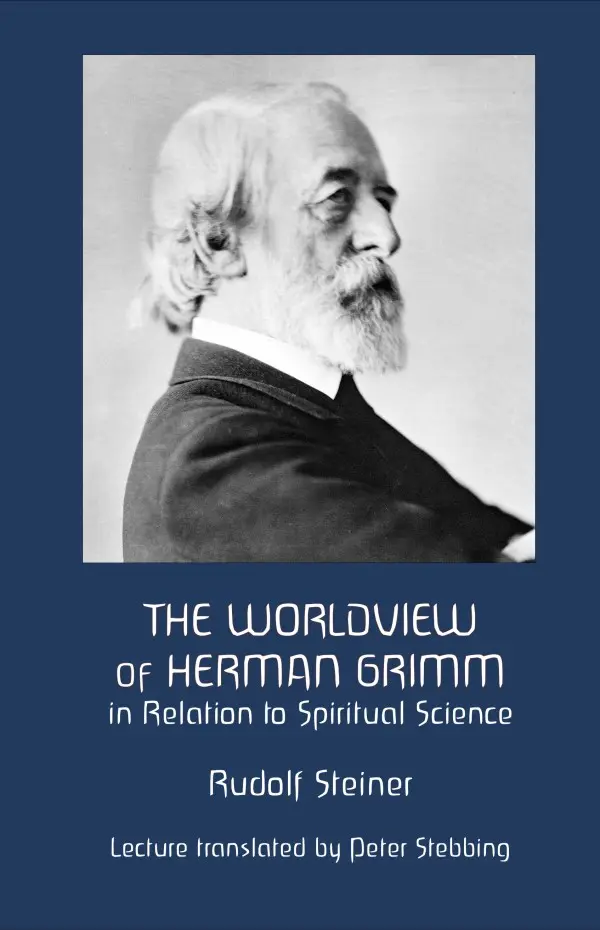


In content, this translation into English of Rudolf Steiner’s lecture on the art historian, author and researcher Herman Grimm, can be said to be a paean to Grimm’s wholly original and unorthodox approach to art history. Herman Grimm’s work differs substantially from standard, more intellectual approaches, as becomes evident from statements of Herman Grimm quoted here:
“If, by some miracle, Michelangelo were called from the dead, to live among us again, and if I were to meet him, I would humbly stand aside to let him pass: if Raphael came by, I would follow him, to see whether or not I might have the opportunity of hearing a few words from his lips. With Leonardo and Michelangelo, one can confine oneself to reporting what they once were in their day; with Raphael, one has to start from what he is for us today. Concerning the two others, a slight veil has passed over them, but not over Raphael. He belongs among those whose growth is as yet far from being at an end. We may imagine that Raphael will present ever new riddles to future generations of humanity.”
This is a lecture, given by Rudolf Steiner, entitled Die Weltanschauung eines Kulturforschers der Gegenwart, Herman Grimm, und die Geistesforschung and contained in the volume Ergebnisse der Geistesforschung (Results of Spiritual Research) GA 62. The series in which this lecture was given at the Architektenhaus in Berlin, may be said to underline its overall importance for Rudolf Steiner: Held January 16th 1913 subsequent to a lecture January 30th on Raphael. Also known as, Herman Grimm, Contemporary Culture and Spiritual Developments, and Anthroposophy. This lecture is the fourth in a series of four lectures from GA 62, that are newly translated by Peter Stebbing.
About the Author
Rudolf Steiner (1861–1925) was born in the small village of Kraljevec, Austro-Hungarian Empire (now in Croatia), where he grew up. As a young man, he lived in Weimar and Berlin, where he became a well-published scientific, literary, and philosophical scholar, known especially for his work with Goethe’s scientific writings. At the beginning of the twentieth century, he began to develop his early philosophical principles into an approach to systematic research into psychological and spiritual phenomena. Formally beginning his spiritual teaching career under the auspices of the Theosophical Society, Steiner came to use the term Anthroposophy (and spiritual science) for his philosophy, spiritual research, and findings. The influence of Steiner’s multifaceted genius has led to innovative and holistic approaches in medicine, various therapies, philosophy, religious renewal, Waldorf education, education for special needs, threefold economics, biodynamic agriculture, Goethean science, architecture, and the arts of drama, speech, and eurythmy. In 1924, Rudolf Steiner founded the General Anthroposophical Society, which today has branches throughout the world. He died in Dornach, Switzerland.


Reviews
There are no reviews yet