
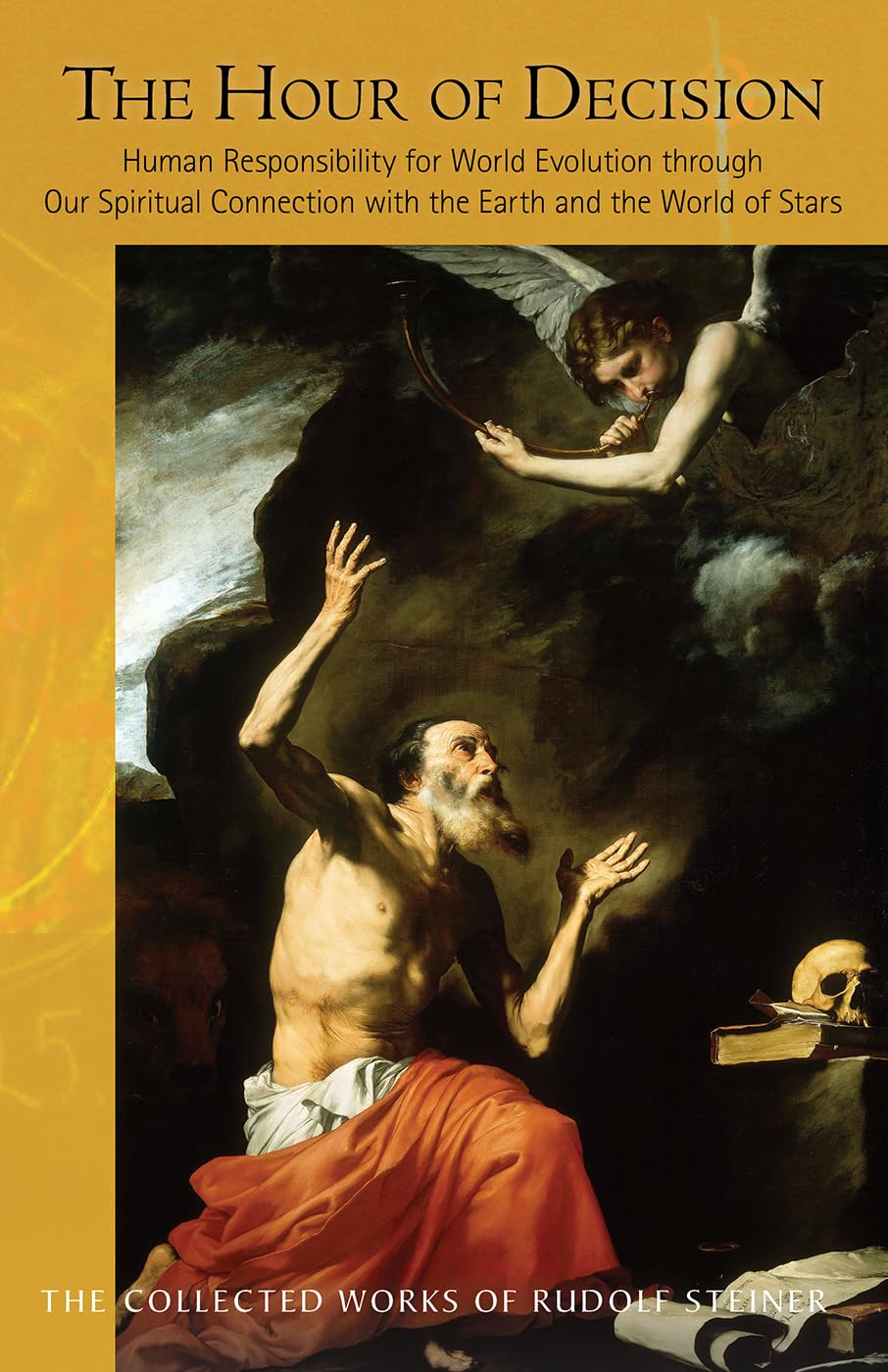


The Hour of Decision: Human Responsibility for World Evolution through Our Spiritual Connection with the Earth and the World of the Stars
Eighteen lectures held in Stuttgart, Dornach, and The Hague from January 1 to April 1, 1921 (CW 203)
“These two things—knowledge of the human being and feeling for the entire cosmos—these are what give the human being equilibrium. But this he can find if, in the most modern sense, he can really grasp the Christ mystery, grasp it as anthroposophical spiritual knowledge can give it to him. For there we speak of Christ as a cosmic being that has descended to the earth from cosmic infinitude. We learn to feel cosmically, and need only imbue this cosmic feeling with content. This we can do only through anthroposophical spiritual science, otherwise the concept of Christ remains empty for us. The concept of Christ turns into mere phrase if we do not grasp the cosmos itself as human.”(Rudolf Steiner, Dornach, January 30, 1921)
Published here for the first time in English, these lectures offer a unique glimpse into Rudolf Steiner’s activity during the challenging post-war years. As Steiner’s work struck ever more broadly and deeply into the wider culture, challenging the status quo in every field of social, cultural, and economic life—with initiatives such as the movement for social threefolding and the founding of the first Waldorf School—unprecedented opposition to anthroposophy arose from all sides, most vehemently from certain academic and clerical circles. The response of the members of the Anthroposophical Society to the opposition, though well intentioned, was often woefully naïve and inadequate. This opposition, together with the lack of wakefulness on the part of the membership of the Anthroposophical Society, would lead, less than two years after these lectures, to the burning of the first Goetheanum on New Years’ Eve 1922/23. Already in the lecture of January 30, 1921, reading the signs of the times, Steiner warned:
If things continue like this, then Ahriman will get his due. . . . The ahrimanic spirit, this cold, ossified, bald Ahriman—if I may express myself pictorially—creeps around our modern centers of learning; he wants them to stay as they are. He will certainly lend a hand if it comes to something like the destruction of this Goetheanum.
The lectures were not intended as a self-contained lecture cycle but were rather spread out over the first months of 1921, some in Stuttgart, one in The Hague, and the rest in Dornach—hence their wide-ranging nature. And yet, a red thread runs through them: a picture of humanity at the hour of decision. The word decision, as if written in golden letters, stands at the heart of these lectures. It appears nearly twenty times in the course of the lectures, as in: “the hour of decision,” “this age of decision,” “a decision that comes from the depths of human nature,” etc. And while Steiner speaks of many decisions facing us today in all aspects of life, at the core of this age of decision lie the three paths open to humanity: the path of Lucifer, the path of Ahriman, and the path of Christ.
This volume is a must-read for anyone seeking deeper insights into the nature of our times and the decisions facing humanity today.
Originally published in German as Die Verantwortung des Menschen für die Weltentwickelung durch seinen geistigen Zusammenhang mit dem Erdplaneten und der Sternenwelt, 3rd edition, by Rudolf Steiner Verlag, Dornach, Switzerland, 2022.
C O N T E N T S
Introduction
Lecture One
Stuttgart, January 1, 1921
The two Christmas proclamations to the Magi and to the shepherds: The Magi experienced a spiritual mathematics in the universe as an echo of prenatal existence. The shepherds learned the mysteries of the earth through their clairvoyance. The Magi received the proclamation of Christ from the lore of the heavens, the shepherds from the revelation of the earth. The metamorphosis of the ancient wisdom of the Magi and the shepherds into contemporary mathematics, into scientific observation, and the need to bring it back to life in imaginative vision.
Lecture Two
Stuttgart, January 6, 1921
A realistic picture of history and an understanding of the present age results from spiritual-scientific research into the reincarnation of certain groups of human souls in different territories: Souls who took up Christianity in southern Europe and in North Africa in the first centuries AD then incarnated largely in Central Europe in the twentieth century; souls who lived as American Indians at about the time of the great discoveries and inventions in Europe then incarnated in Europe in the twentieth century; souls who took up Christianity from the south around the time of the migration of peoples in Europe then incarnated in the twentieth century in Asia, especially in Japan; souls who lived as non-Christians in the Near Eastern cultures at the time of the Mystery of Golgotha then sought their next incarnation in the twentieth century in America.
Lecture Three
Stuttgart, January 9, 1921
The difficulty of many souls to incarnate today. The transformation of the soul constitution in Central European humanity. Tendencies to eradicate Central European spirituality. Central Europe between the tendency towards unworldly mysticism in the East and materialism in the West. Hegel, Goethe, Schiller as pioneers of a synthesis between East and West.
Lecture Four
Stuttgart, January 16, 1921
The great tasks of our time. The gulf between faith and knowledge, both in the face of the empty ideas of science and the no longer understood dogmas of religious denominations. The impossibility of connecting with the experience of earlier incarnations. The danger of decline and the death of the soul. The necessity of the spiritualization of natural knowledge; its contradictory tendencies. The untruthfulness of the present age and the necessary use of the will against it. Anthroposophy as a matter of the spiritual worlds; the strengthening of anthroposophical life.
Lecture Five
Dornach, January 21, 1921
Spiritual science must permeate real life. The view of pre-existence as a life force. The connection of the human being with the environment: plant world; formation of coal. The discarded physical bodies and the earth. The future transformation of moral ideas into natural law, of spiritual knowledge into social power. Materialism and spiritualism. Instinctive vision and today’s intellect. The necessary transformation of social forces through the light of imagination. The dangers in social and economic thinking through the superficiality of the present.
Lecture Six
Dornach, January 22, 1921
That which was taught from out of the mysteries to the people of earlier times is brought into life today by children from the instruction they receive before birth, and education must work in such a way that growing human beings can develop out of themselves what they have brought with them. The human being of pre-Christian cultures was born into social contexts not only through heredity, but also through the work of the spiritual world before birth.
Lecture Seven
Dornach, January 23, 1921
The great changes in all areas of life in the second half of the nineteenth century. Document from the Sonderbund War. Social threefolding and its connection with practical life. Development of economic life from the national economy to the world economy. The cotton industry. The young Rudolf Steiner’s personal insights into the textile trade. Attacks against anthroposophy. The need to protect the Goetheanum from the opponents’ will to destroy it.
Lecture Eight
Dornach, January 29, 1921
The connection of man with the earth between birth and death, with the starry world between death and new birth. The spiritual beings that work behind the appearances of the senses. Ahriman and Lucifer. The starry sky as a revelation of the luciferic beings, the earth as a revelation of the ahrimanic beings. The necessity of finding a balance between the two. The consequence of nebulous mysticism: not being able to age in the next incarnation. Ahriman’s striving to prevent future incarnations. The present hour of decision for humanity, in which the balance must be found. The necessity of a geosophy and cosmosophy.
Lecture Nine
Dornach, January 30, 1921
The striving for balance between the luciferic and ahrimanic aberrations. Ahrimanization through modern science. Modern technology: a corpse of nature. Luciferization in social life. The task of spiritual science is to bring knowledge of the being of man to external science, as well as cosmic feeling to social life. The emergence of a social mood and the fertilization of social life through knowledge of the world. The renewal of Christianity.
Lecture Ten
Dornach, February 5, 1921
Review of the essay, “Drei Welten” [Three worlds], by Hsi-Lung in the journal Hochland. The relationship of Asians to modern Europeans. The ancient Asians and even the early Greeks experienced divine beings as the inspirers of all culture. The essence of Greek epic, drama, and poetry. Today’s Asians still live in the decadence of this view and judge modern Europeans as soulless, and they feel misunderstood by Europeans. The work and aims of Catholicism. Review of the book Die Heimkehr des Ketzers [The return of the heretic] by H. Ehrenberg.
Lecture Eleven
Dornach, February 6, 1921
Today’s life of imagination is penetrating into areas which in earlier times were considered beyond the threshold of knowledge because self-consciousness was not yet equal to them. The strengthening of self-consciousness in modern times. Anthroposophy’s view of the threshold for modern consciousness. Catholicism as a great worldview rooted in the past. The task of bringing spiritual knowledge into the modern view of nature. The dangers of Catholicism and Orientalism. The necessity of a strengthened sense of truth. The memoirs of Paléologue. Opponents of anthroposophy; Frohnmeyer, Heinzelmann.
Lecture Twelve
Dornach, February 8, 1921
Since anthroposophy came before the world with the building of the Goetheanum, it is no longer possible to practice mysticism in small sectarian circles. What is needed is a new sense of responsibility towards anthroposophy and an understanding of the world. The world is hostile to the stronger emergence of anthroposophy. It is necessary not only to defend ourselves but also to characterize our opponents. Dessoir, article in the February 1921 issue of Die Tat on anthroposophy.
Lecture Thirteen
The Hague, February 27, 1921
The Greeks lived through the age of the intellectual soul in youthful freshness; in Roman times, a decadence had already set in. We have taken thinking into the consciousness soul as the inheritance of the culture of the intellectual soul. This gave rise to egoism as a stage in the development towards freedom. Anthroposophical knowledge and the tasks of humanity in the present. The Mystery of Golgotha was initially understood with the remnants of the old clairvoyance. From 333 to 869 (Council of Constantinople), this knowledge became theology. Adolf von Harnack. Entering during sleep into the experiences of souls who are not yet incarnated; aftereffects of the inheritances of earthly life while awake. The necessity of spiritual knowledge; the task of the anthroposophical movement.
Lecture Fourteen
Dornach, March 11, 1921
Report on the lecture tour in the Netherlands in February 1921. The university philosopher Jürgen Bona Meyer. The “School of Wisdom” of Count Hermann Keyserling. The threefold structure of the human being. Human beings sleep through the life of the will and its physical counterpart, the metabolic life of the limbs, which is embedded in the Elohim. The aims of the luciferic and ahrimanic beings in Earth evolution: The luciferic spirits are Elohim who remained behind; they work into the head life and give man reason, but do not want to let him descend into full earthly existence. They want to bind people to the past. The ahrimanic spirits are beings of the first hierarchy who remained behind. They want to detach man from the past and make him a starting point for an evolution in the mineral kingdom. Striving for a balance between the luciferic and the ahrimanic in the Christ-principle, through spiritual science.
Lecture Fifteen
Dornach, March 13, 1921
Spiritual beings in the various realms of existence. The dominion of Yahweh in the three upper kingdoms of nature, the warmth, the air, and the water. The mineral element, alien to Yahweh, as the basis of the intellectual culture of the Christian era. The dreamlike understanding of the Mystery of Golgotha in the first centuries. Saul – Paul. Aftereffects of the old Yahweh religion. The intervention of Lucifer in the Yahweh realm, Ahriman in the mineral realm, in order to cut man off from pre-existence. Attacks against spiritual science.
Lecture Sixteen
Dornach, March 27, 1921
The contrast between the Christmas thought and the Easter thought. Birth and resurrection. Changes in the Easter thought in the course of history: The triumph over death is the Easter thought in the time of early Christianity, in which the wisdom of the Orient still lived. Later, around the time of the Eighth Ecumenical Council of Constantinople (869), it was replaced by Christ as the juridical judge of the world and Christ as the Man of Sorrows, as an expression of humanity’s entry into materialism. Sentimentality about the infant Jesus also replaced the mystery of his birth. The rediscovery of the spiritual Christ in the human soul, in the human will as a task of the age. Setting the date for Easter.
Lecture Seventeen
Dornach, March 28, 1921
Christ Jesus and Apollonius of Tyana. The outward similarities in their lives. The life, teachings, and travels of Apollonius; his wisdom gathered on the earth. The wisdom of Christ Jesus brought down from extraterrestrial worlds. In the past, wisdom was bound to certain places on the earth; today, wisdom is absorbed into the individual will of man. The resurrection impulse of spiritual science. The intention of the anthroposophical movement and its practical institutions. The demand of the present for a new culture of the will.
Lecture Eighteen
Dornach, April 1, 1921
The significance of human development in connection with the development of the earth. The present inwardness of the intellect as a metamorphosis of the intellect in the laws of nature, which formerly worked outside the human being. Today’s natural science hovers impersonally above the human being. Luciferic spirits wait for intellectual culture that is not grasped by the heart. Ahrimanic spirits wait for the desires that arise when the will is not individually transformed into pure thinking. East and West. The moon as an image of what could become of the earth. Personally formed thinking and individual will transformed into love make man a co-creator in the metamorphosis of Earth evolution.
Editorial and Reference Notes
Rudolf Steiner’s Collected Works
Significant Events in the Life of Rudolf Steiner
Index
Rudolf Steiner’s Blackboard Drawings
About the Author
Rudolf Steiner (b. Rudolf Joseph Lorenz Steiner, 1861–1925) was born in the small village of Kraljevec, Austro-Hungarian Empire (now in Croatia), where he grew up. As a young man, he lived in Weimar and Berlin, where he became a well-published scientific, literary, and philosophical scholar, known especially for his work with Goethe’s scientific writings. At the beginning of the twentieth century, he began to develop his early philosophical principles into an approach to systematic research into psychological and spiritual phenomena. Formally beginning his spiritual teaching career under the auspices of the Theosophical Society, Steiner came to use the term Anthroposophy (and spiritual science) for his philosophy, spiritual research, and findings. The influence of Steiner’s multifaceted genius has led to innovative and holistic approaches in medicine, various therapies, philosophy, religious renewal, Waldorf education, education for special needs, threefold economics, biodynamic agriculture, Goethean science, architecture, and the arts of drama, speech, and eurythmy. In 1924, Rudolf Steiner founded the General Anthroposophical Society, which today has branches throughout the world. He died in Dornach, Switzerland.



Reviews
There are no reviews yet