
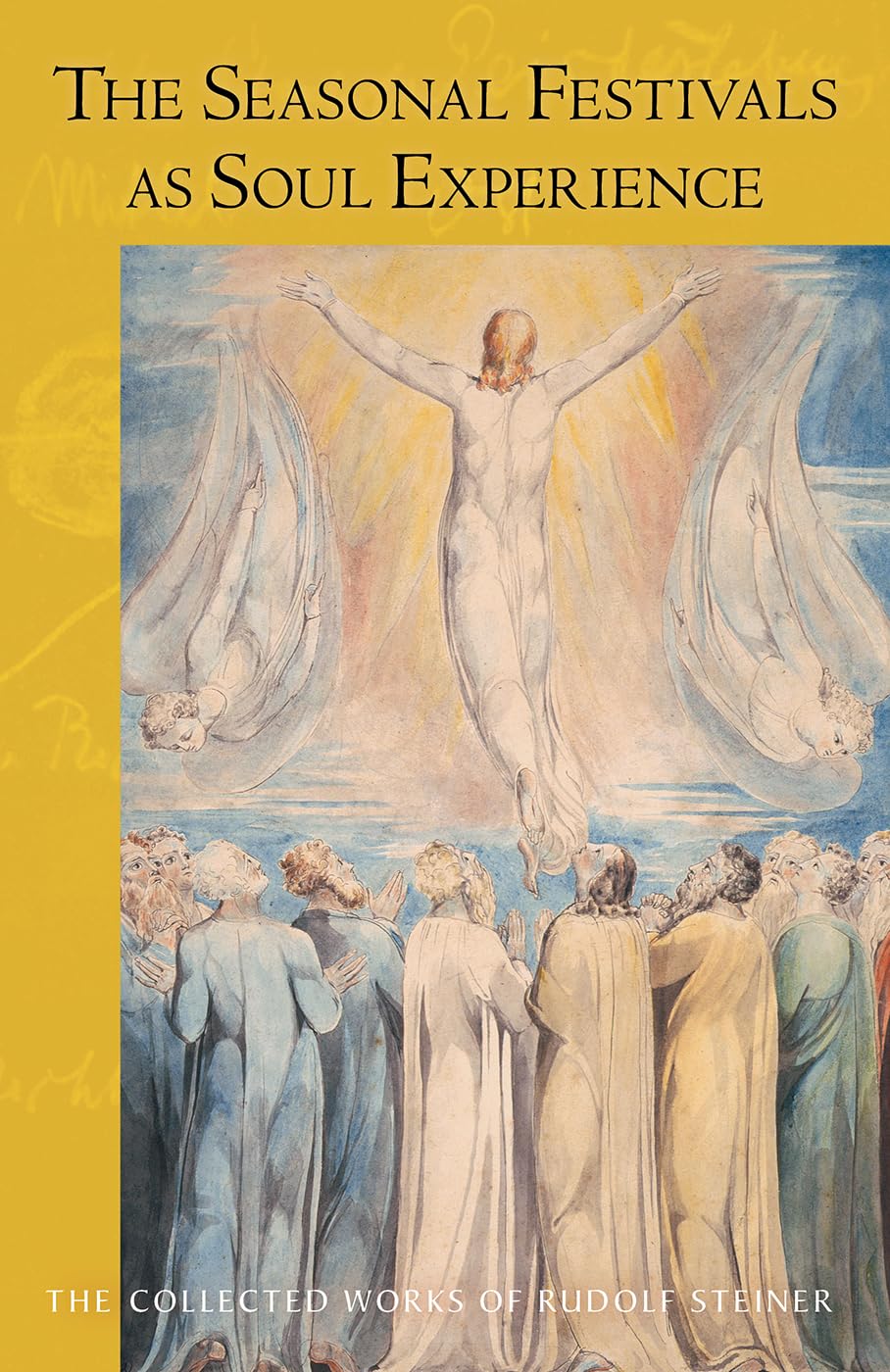

Eleven Lectures held in Bern, Dornach, Prague, Stuttgart, and Berlin from April 6 to July 11, 1923 (CW 224)
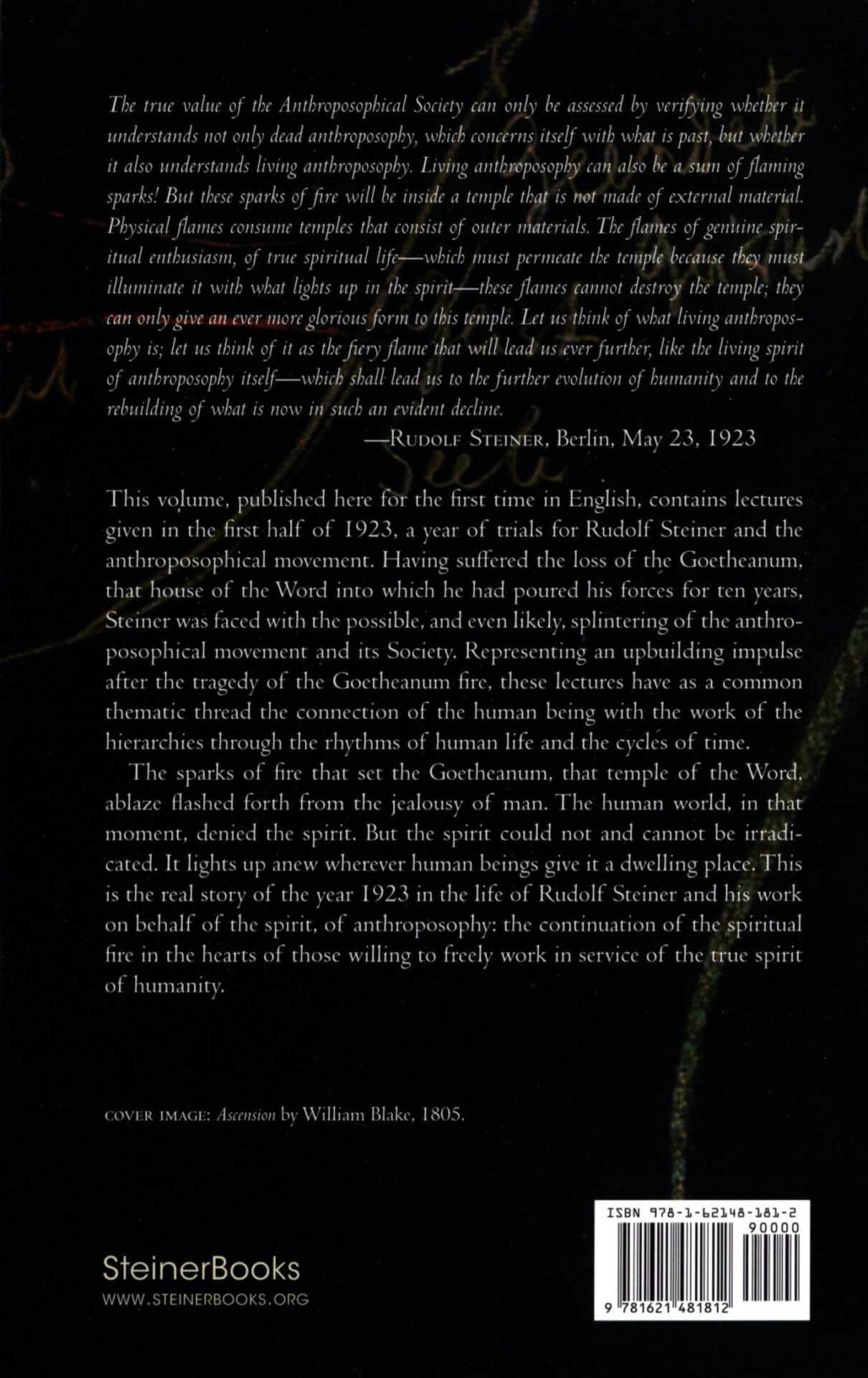
“The true value of the Anthroposophical Society can only be assessed by verifying whether it understands not only dead anthroposophy, which concerns itself with what is past, but whether it also understands living anthroposophy. Living anthroposophy can also be a sum of flaming sparks! But these sparks of fire will be inside a temple that is not made of external material. Physical flames consume temples that consist of outer materials. The flames of genuine spiritual enthusiasm, of true spiritual life—which must permeate the temple because they must illuminate it with what lights up in the spirit—these flames cannot destroy the temple; they can only give an ever more glorious form to this temple. Let us think of what living anthroposophy is; let us think of it as the fiery flame that will lead us ever further, like the living spirit of anthroposophy itself—which shall lead us to the further evolution of humanity and to the rebuilding of what is now in such an evident decline.” —Rudolf Steiner, Berlin, May 23, 1923
This volume, published here for the first time in English, contains lectures given in the first half of 1923, a year of trials for Rudolf Steiner and the anthroposophical movement. Having suffered the loss of the Goetheanum, that house of the Word into which he had poured his forces for ten years, Steiner was faced with the possible, and even likely, splintering of the anthroposophical movement and its Society. Representing an upbuilding impulse after the tragedy of the Goetheanum fire, these lectures have as a common thematic thread the connection of the human being with the work of the hierarchies through the rhythms of human life and the cycles of time.
The title of the volume is drawn especially from the later lectures, which are centered around a renewal of the seasonal festivals. Rudolf Steiner speaks about Easter, Ascension and Pentecost, St. John’s, and Michaelmas, illuminating new paths toward the celebration of true festivals in our time.
The Berlin lecture on the founding of a new Michael Festival is of particular significance. It was the last that Rudolf Steiner ever gave in Berlin, the city where he had lived and worked on behalf of anthroposophy for many years. In the lecture, Rudolf Steiner draws a parallel between the autumn and spring seasons. Just as we experience the death and resurrection through the spring festival of Easter, so, in the autumn, when outer nature dies away and the human being hears the inner call to awaken, he can, out of his inner forces of consciousness during earthly life, experience a resurrection in spirit before death, so that when he passes through the gate of death, he will have first accomplished this resurrection and will thereby find his rightful path in the spiritual worlds. Thus the death and resurrection at Easter is mirrored in the resurrection and death at Michaelmas. This inner path of Michaelic self-transformation leads to the possibility of moving beyond mere talk about social change to an actual capacity to become socially creative, not merely to understand through the head the meaning of the old festivals, but rather to create festivals out of an inner sense for the course of the year, out of a will to awaken.
The sparks of fire that set the Goetheanum, that temple of the Word, ablaze flashed forth from the jealousy of man. The human world, in that moment, denied the spirit. But the spirit could not and cannot be irradicated. It lights up anew wherever human beings give it a dwelling place. This is the real story of the year 1923 in the life of Rudolf Steiner and his work on behalf of the spirit, of anthroposophy: the continuation of the spiritual fire in the hearts of those willing to freely work in service of the true spirit of humanity.
C O N T E N T S
Introduction
The Forming of Destiny in Sleeping and Waking
The Spirituality of Language and the Voice of Conscience
Bern, April 6, 1923
Walking, speaking, and thinking in their relationship to the state of sleep. During sleep, the astral body carries the soul-spiritual aspects of speech to the Archangeloi; the I carries the moral aspects of our movements and actions to the Archai. For this to happen, idealism must be present in our speech, and love of humanity in our actions. From this connection with the hierarchies, the human being weaves, between death and rebirth, the karma and the dexterity of the next life. The difference of past and present karma. While awake, even higher hierarchies, the Exusiai and Kyriotetes, transfer the spirituality of speech into the inclinations and desires of the physical body; the Dynamis integrate our love of humanity into the physical body. During sleep, our thoughts remain in the etheric body and connected to the physical body; as a result, the human being can achieve freedom through pure thinking in earthly life.
The Individualized Logos and the Art of Extracting the Spirit from the Word
Stuttgart, May 2, 1923
As the senses quiet down during sleep, an inner activity awakens within them: an etheric light, sound, and warmth. It is the life and activity of the Exusiai and consists of thought-forms that express the essence of the human being in inner words. The essential element in these words is the Dynamis. From this light, sound, and warmth, an etheric organism flows together at the front of the human being: the lotus flowers, a manifestation of the Kyriotetes. After death, these manifestations of the second hierarchy dissipate with the etheric body. The human being experiences these manifestations while overcoming individual shortcomings and then ascends into the spirit-land where the hierarchies can be perceived. The sounding-together of the hierarchies is the Logos, which Christ has condensed within his own being. The dreamlike consciousness of these things eventually shrank to Leibnitz’s concept of “monads.” Thinking, speaking, and the realm of movements are manifestations of the third hierarchy in their working together with the first hierarchy.
Our Thought Life in Sleeping and Waking and in the Existence after Death
Stuttgart, June 21, 1923
In earthly life, the life of thought is the most valuable thing for human beings. The life of emotions and of will works from the unconscious, just as it also works unconsciously during sleep. Thoughts live in the physical and etheric bodies. After death, they melt away as these bodies dissolve. But what the I and the astral body unconsciously experienced during the nights—going over our earthly life in the light of the moral world order—now becomes conscious. From what is experienced spiritually the spiritual germ of our next earthly life is formed. Then we can no longer perceive the spirit world and develop an interest in our new earthly life and our ancestors before we descend again. We grow into our physical heredity from the spiritual world. Our spiritual origin becomes embedded in the nerves, the earthly side lives in the blood. Freedom exists only in the pivoting point of the two balance beams: offspring of heaven versus seed of the earth, spiritual determination versus natural causality.
The Hollowness of Words and the Shallowness of Contemporary Thinking
An Evaluation of Mauthner, Rubner, Schweitzer
Stuttgart, July 4, 1923
In his Critique of Language, Fritz Mauthner points to the unreality of our words with respect to the word “soul.” Anthroposophy points to the reality—thinking as a reflection of the physical brain and as the sculpting quality of thought-force in the formation of the body; feeling as an earthly phenomenon and as a legacy from pre-earthly life, directed toward the spirit; willing as a conscious experience and as something eternal that is working on karma. Then there are realities behind the words thinking, feeling, and willing. The lack of clarity of contemporary thinking, illustrated in a speech of Max Rubner. The lack of wakefulness in thinking, illustrated in Albert Schweitzer’s recent publication.
The Four Members of the Human Being
Intellectual Thinking versus the Moral-Religious Experience
Stuttgart, July 11, 1923
The four members of the human being come from four different worlds: the physical body from the earth world containing earthly laws, the etheric body from the etheric world, which intensifies at the periphery of the world; the astral body from the astral realm where earthly law transitions to cosmic law; the I from yet another world. Each of these worlds has its own laws. Their working together gives rise to the human being. The possibility of freedom arises because of the separation of the etheric body and physical body from the astral body and the I during sleep. The nourishment of the soul is morality and religion, which today, with our bodies being permeated by electrical currents, can only be attained through increased strength. The Anthroposophical Society aims to develop this strength.
Three Stages in the Awakening of the Human Soul
Prague, April 28, 1923
As the child develops, it learns to walk, speak, and think. Thinking can only develop from speaking. In our pre-earthly existence, we live in a living stream of thought with the Angeloi; from this, the forces of thinking develop in earthly life; from our association with the Archangeloi, we gain the ability to speak; from our association with the Archai, we gain the forces of standing upright and using our limbs. In our earthly life, we enter into a relationship with these higher beings each time we sleep, but in order to do this in the right way, we need idealism in thought, speech, and deeds. This leads us after death to a conscious relationship with the first hierarchy. In the next life, the consequences of our previous earthly life appear in the form of learning to walk in association with the Archai; learning to speak is made possible by the Archangeloi in conjunction with the second hierarchy; thinking is given to us by the Angeloi in association with the first hierarchy.
Anthroposophy as a Path toward a Deeper Understanding of the Mystery of Easter
Prague, April 29, 1923
The soul life of humanity is transformed in the course of development. Until the fourth century AD, the pre-earthly living thinking continued in earthly life. Then humanity advanced toward dead thinking, which allows for an awareness of freedom. The appearance of Christ was still experienced through living thinking as the appearance of the only divine being who descended from the pre-earthly into the earthly realm through birth and death and who came from the sun to the earth to share humanity’s fate of going through birth and death. Through Christ’s overcoming of death, the fear of the finality of death was overcome. Gnosis still held on to these spiritual views. Augustine could no longer understand them. Today they have been completely lost. Christ is seen as the “simple man from Nazareth”; Ranke’s historiography without the Christ-event. The connection with Christ must be spiritually rediscovered. Anthroposophy provides the tools.
The Revelation of Ascension and the Mystery of Pentecost
Dornach, May 7, 1923
The picture of Ascension seems to contradict the fact that Christ will remain with the earth forever. Since the midpoint of the evolution of the earth in the middle of Atlantis, the earth has been dying, along with plants, animals, and physical human beings. The geologist, Eduard Suess, confirms the dying of the mineral element. The etheric body of the human being tends to strive toward the sun, so that humanity would no longer be able to incarnate in the future. Christ gave the etheric body and the physical body new strength. The Mystery of Golgotha is an objective occurrence; it took place for all human beings, regardless of their creeds or affiliations. The disciples experienced this in the Ascension image. In the Pentecost experience, they felt the Christ-force entering the I and the astral body; to experience this, the individual human being must acquire an understanding of the Mystery of Golgotha. After death, every human being experiences both images.
The Mood of Saint John’s
The Heightened Awareness at Saint John’s Tide
Dornach, June 24, 1923
The physical body lives in the daily cycle, the soul in the yearly cycle, the spirit in the passage of time. New tendencies in thinking and feeling among the younger generation point to a new era. It demands spiritual vision as a counterbalance to the narrow horizons of materialism. Example given: Attempts to make plant growth independent of cosmic influences were only successful because researchers made use of ahrimanic sunlight, electricity, which has its origin in the recapitulation of the Sun phase during the Earth phase of evolution. This kind of research needs a spirit-based counter pole through anthroposophy. The appropriate mood of St. John’s tide can be achieved by sharpening our understanding of today’s world-historical moment.
Regaining the Living Source of Speech through the Christ-impulse
The Michael-thought as an Appeal to the Human Will
Dornach, April 13, 1923
The evolution of human language is a reflection of the development of the Archangeloi, the spirits of language. Until the later Atlantean period, language was an expression of will, because the Archangeloi received it as intuition from the second hierarchy; until the Greek period, language was an expression of feeling, because the Archangeloi received it as inspiration from the first hierarchy; since the Roman period, the Archangeloi have had to draw it from the past, because there is no hierarchy above the first, resulting in ahrimanic influences. It became a language of thought. The hierarchies themselves go through an evolution as well. Herman Grimm sensed what this transition from Greek to Roman culture signified. Through the Mystery of Golgotha, human beings will be able to develop language again from a dead thought-language to a language of feeling and will. Past evolution is presented at the beginning of the Gospel of John; the Michael-thought points to development into the future.
Creating a Michael Festival out of the Spirit
The Mystery of the Inner Human Being
Berlin, May 23, 1923
The true nature of a child’s learning to walk, speak, and think can be seen by observing the life of sleep. Human beings evolved from the spiritual into the material in order to become free. One example given is the musical experience in Atlantean times (interval of the seventh), post-Atlantean times (interval of the fifth), and modern times (major and minor thirds). Each time we sleep, we spiritually relive our actions, speech, and thoughts of the last time we were awake. This then becomes the content of our life after death, after the etheric body has dissolved. After that, the spiritual world becomes our environment, with which we build our next earthly body, weaving our karma into it. This life with the Archai is reflected in learning to walk; experiencing the spiritual beings only as revelation is reflected in learning to speak; gathering our etheric body is reflected in learning to think. The Michael Festival is to be created as a new festival out of the spirit. It should be dedicated to understanding the resurrection of the spiritual in human life, so that human beings can then pass through death in the right way. Easter celebrates the passage through death and the resurrection after death. The meaning of a Michael Festival is its significance for social life.
Editorial and Reference Notes
Rudolf Steiner’s Collected Works
Significant Events in the Life of Rudolf Steiner
Index
Rudolf Steiner’s Blackboard Drawings
About the Author
Rudolf Steiner (b. Rudolf Joseph Lorenz Steiner, 1861–1925) was born in the small village of Kraljevec, Austro-Hungarian Empire (now in Croatia), where he grew up. As a young man, he lived in Weimar and Berlin, where he became a well-published scientific, literary, and philosophical scholar, known especially for his work with Goethe’s scientific writings. At the beginning of the twentieth century, he began to develop his early philosophical principles into an approach to systematic research into psychological and spiritual phenomena. Formally beginning his spiritual teaching career under the auspices of the Theosophical Society, Steiner came to use the term Anthroposophy (and spiritual science) for his philosophy, spiritual research, and findings. The influence of Steiner’s multifaceted genius has led to innovative and holistic approaches in medicine, various therapies, philosophy, religious renewal, Waldorf education, education for special needs, threefold economics, biodynamic agriculture, Goethean science, architecture, and the arts of drama, speech, and eurythmy. In 1924, Rudolf Steiner founded the General Anthroposophical Society, which today has branches throughout the world. He died in Dornach, Switzerland.




Reviews
There are no reviews yet