
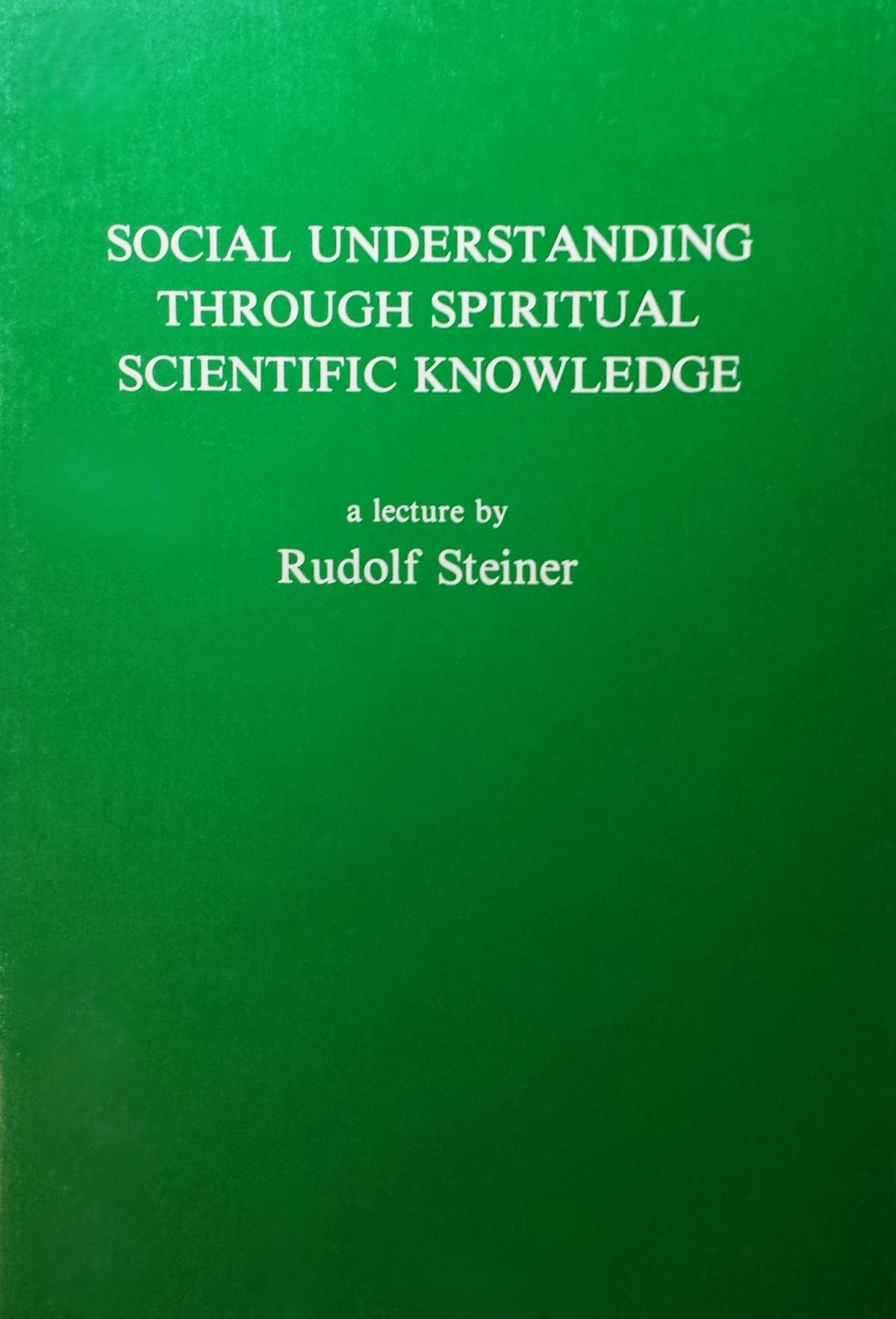



Social Understanding Through Spiritual Scientific Knowledge
Dornach, October 4, 1919 (GA 191)
This lecture makes clear the continuity and interwovenness of body, soul, and spirit in all human life.
“In the middle one of these three lectures there are a number of anthroposophical truths in particular that I would like to develop for you. We shall then see what a great impact on a person’s everyday life these particular truths have, and that is what we will talk about tomorrow. Today I just want to draw your attention to some deeper aspect of the being of man.
People very often do not ask the question as to which of man’s forces are used to acquire knowledge of super-sensible worlds. They try to answer this question merely by saying that there is a possibility of acquiring super-sensible knowledge by means of certain forces in man. But what the actual connections are between these forces and man’s being, they do not usually ask. That is why so little importance is attached to making knowledge of super-sensible worlds really fruitful in ordinary life. It can be said that super-sensible knowledge is becoming more and more essential to man, just in our time. In that case it is vital to understand what its connection is with ordinary everyday life.”
About the Author
Rudolf Steiner (1861–1925) was born in the small village of Kraljevec, Austro-Hungarian Empire (now in Croatia), where he grew up. As a young man, he lived in Weimar and Berlin, where he became a well-published scientific, literary, and philosophical scholar, known especially for his work with Goethe’s scientific writings. At the beginning of the twentieth century, he began to develop his early philosophical principles into an approach to systematic research into psychological and spiritual phenomena. Formally beginning his spiritual teaching career under the auspices of the Theosophical Society, Steiner came to use the term Anthroposophy (and spiritual science) for his philosophy, spiritual research, and findings. The influence of Steiner’s multifaceted genius has led to innovative and holistic approaches in medicine, various therapies, philosophy, religious renewal, Waldorf education, education for special needs, threefold economics, biodynamic agriculture, Goethean science, architecture, and the arts of drama, speech, and eurythmy. In 1924, Rudolf Steiner founded the General Anthroposophical Society, which today has branches throughout the world. He died in Dornach, Switzerland.



Reviews
There are no reviews yet