
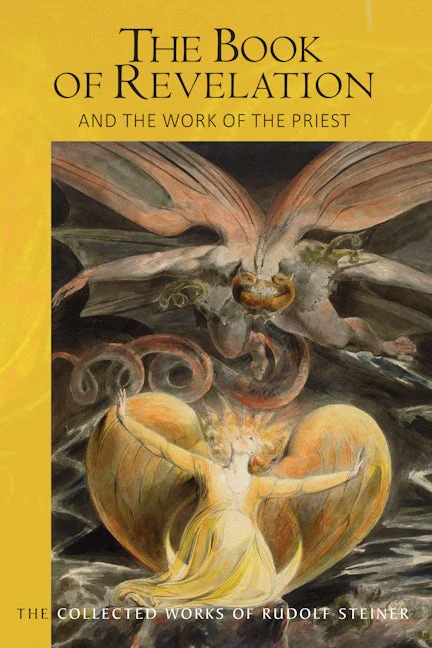

The Book of Revelation and the Work of the Priest
18 lectures, conversations & question-and-answer sessions, Dornach, September 5–22, 1924 (CW 346)
The imagery of the Book of Revelation – St John’s Apocalypse – has inspired centuries of interpretation, much of it symbolic or speculative. In this exceptional series of lectures, Rudolf Steiner approaches the least understood of Christian texts from a fundamentally different standpoint: that of direct spiritual perception and experiential knowledge.
Steiner presents the Apocalypse not as a prophecy of distant events, but as a living book of initiation that addresses the evolution of human awareness, the sacramental life, and the future tasks of Christianity. The Apocalypse unfolds as a cosmic and historical drama: the Alpha and Omega of consciousness, the meaning of its sacred numbers, letters, seals, and trumpets, and the downfall of the powers opposing the Christ Impulse. The Michael and Sun mysteries, the significance of 666 and the images of Babylon, the Beast and the New Jerusalem are explored in relation to karma, freedom, and morality.
The Apocalypse emerges as a spiritual guide for our time, demanding engagement of the will and conscious striving. Central to this vision is the changing experience of the Communion service through successive Mystery epochs, culminating in a future knowledge of the human I. By revealing the unity of cosmic and earthly processes, religion, and knowledge, Steiner presents the Book of Revelation as a living source for humanity’s future development and the renewal of priestly work.
About the Author
Rudolf Steiner (1861–1925) was an Austrian philosopher, social reformer, architect, and esotericist whose lifework laid the foundation for anthroposophy. His insights led to innovative, holistic approaches in medicine, science, education (Waldorf schools), special education, philosophy, religious renewal, economics, agriculture (biodynamics), architecture, and the arts of drama, speech, and eurythmy. In 1924 he founded the General Anthroposophical Society, which today has branches throughout the world. He died in Dornach, Switzerland.
Reviews
There are no reviews yet