
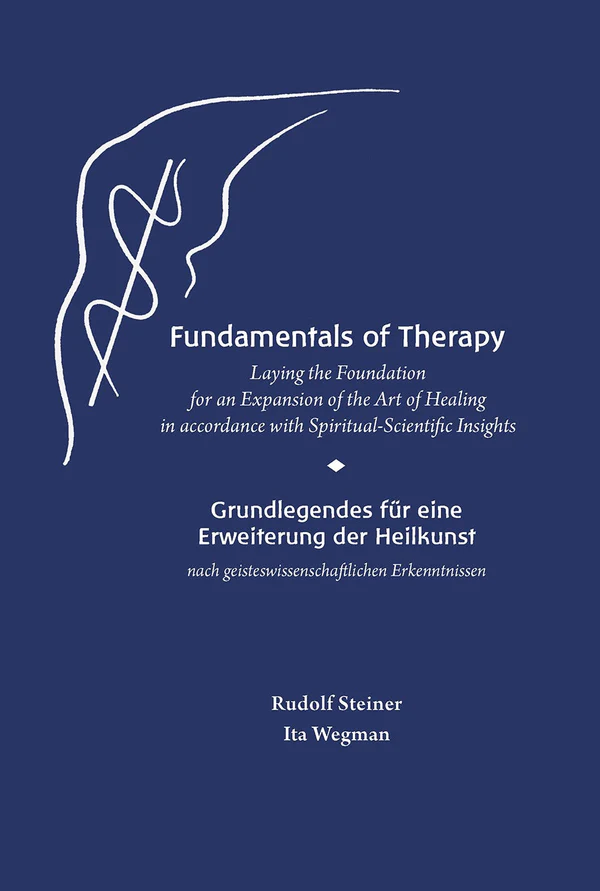

Fundamentals of Therapy: Laying the Foundation for an Expansion of the Art of Healing in accordance with Spiritual-Scientific Insights
Grundlegendes für eine Erweiterung der Heilkunst: nach geisteswissenschaftlichen Erkenntnissen (CW 27)
Bilingual Edition / Zweisprachige Ausgabe (CW 27)
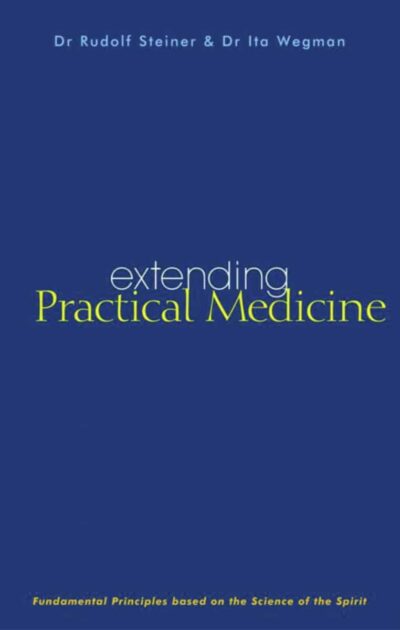
This is a revised translation by Dr. Christina van Tellingen and Dr. Ricardo Bartelme. It is the only book written by Rudolf Steiner with a co-author. Presented in the original German with facing pages in English translation, it introduces a new method of medical practice, complementing natural-scientific medicine through the methods and contents of anthroposophical spiritual science. It does not merely impart information, but permits, even requires, the active reader to undergo a training, a development of new capacities. These new capacities permit the practitioner to come to insights into the spiritual aspects of illness, healing substances, and healing processes. Thus, this book is a guide on the path of initiation into the mysteries of healing, so that the practice of medicine can be truly humanized.
C O N T E N T S:
Foreword
Translator’s note
Chapter I: True Insight into the Nature of the Human Being as a Foundation for the Art of Medicine
Chapter II: Why Does the Human Being Become Ill?
Chapter III: The Manifestations of Life
Chapter IV: On the Nature of the Sentient Organism
Chapter V: Plant, Animal, Human Being
Chapter VI: Blood and Nerve
Chapter VII: The Nature of Healing Functions
Chapter VIII: Activities in the Human Organism. Diabetes Mellitus
Chapter IX: The Role of Protein in the Human Body and Albuminuria the Deceptive Local Symptom Complexes
Chapter XII: Upbuilding and Secretion in the Human Organism
Chapter XIII: On the Essential Nature of Being Ill and of Healing
Chapter XIV: About the Therapeutic Way of Thinking
Chapter XV: The Healing Process
Chapter XVI: Insight into Medications
Chapter XVII: Knowledge of Substances as a Basis for Insight into Medication
Chapter XVIII: Eurythmy Therapy
Chapter XIX: Characteristic Case Histories
Chapter XX: Typical Medications
Preface to the First Edition
Postscript
Appendices
1. How did the Medical Book Arise?
by M.P van Deventer
2. A New Mystery Book
by W. Holtzapfel
Notes
About the Author
Rudolf Steiner (1861–1925) was born in the small village of Kraljevec, Austro-Hungarian Empire (now in Croatia), where he grew up. As a young man, he lived in Weimar and Berlin, where he became a well-published scientific, literary, and philosophical scholar, known especially for his work with Goethe’s scientific writings. At the beginning of the twentieth century, he began to develop his early philosophical principles into an approach to systematic research into psychological and spiritual phenomena. Formally beginning his spiritual teaching career under the auspices of the Theosophical Society, Steiner came to use the term Anthroposophy (and spiritual science) for his philosophy, spiritual research, and findings. The influence of Steiner’s multifaceted genius has led to innovative and holistic approaches in medicine, various therapies, philosophy, religious renewal, Waldorf education, education for special needs, threefold economics, biodynamic agriculture, Goethean science, architecture, and the arts of drama, speech, and eurythmy. In 1924, Rudolf Steiner founded the General Anthroposophical Society, which today has branches throughout the world. He died in Dornach, Switzerland.
Dr. Ita Wegman (1876–1943) was born in the Dutch East Indies. She trained in gymnastics and massage and later in medicine.. She became a close student of Rudolf Steiner, who encouraged her to acquire a medical degree. She later founded the Institute of Clinical Medicine in Arlesheim, Switzerland, where she developed a medical practice based on principles of spiritual science. She was made leader of the Medical Section of the Anthroposophical Society in 1923 and, during her last years, devoted herself to work in the clinic, where she died.
Reviews
There are no reviews yet