
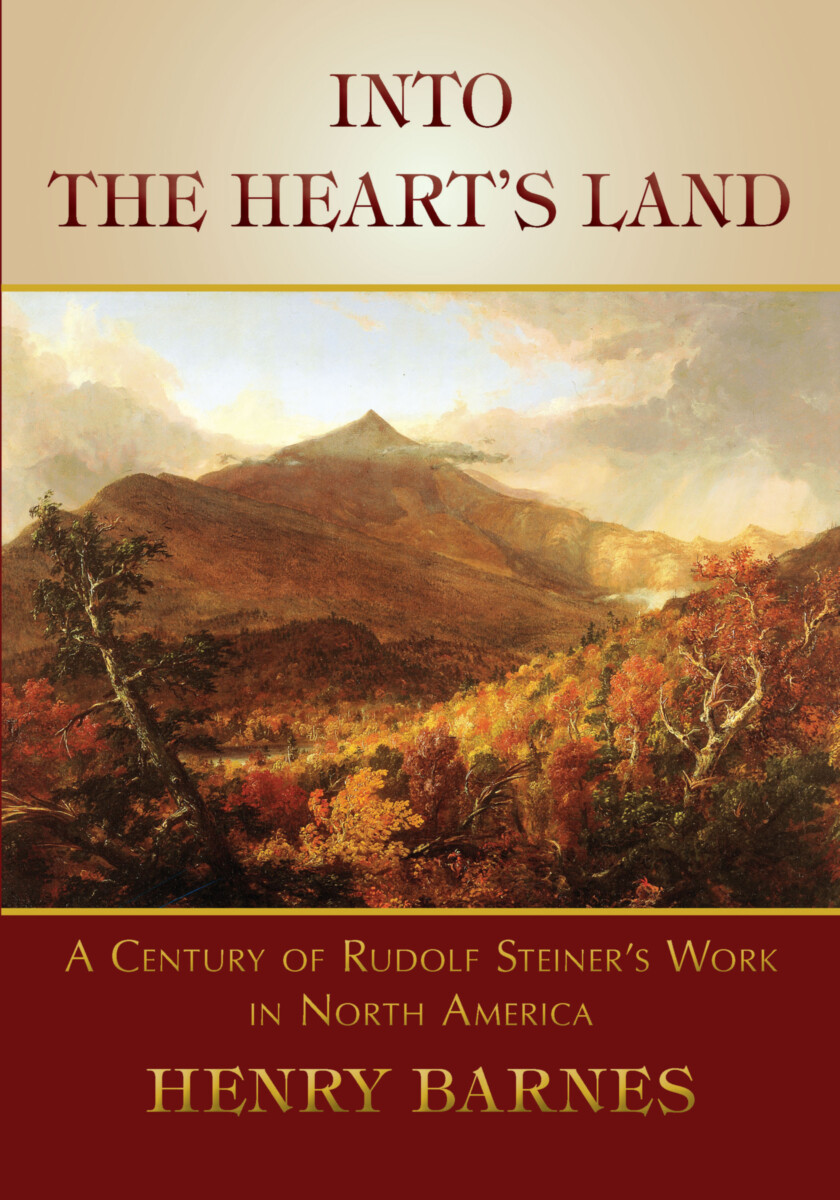

Into the Heart’s Land: A Century of Rudolf Steiner’s Work in North America
“The actual victor is the being of the Anglo-American peoples, and, as a result of forces that I have often described here, this being of the Anglo-American peoples is destined to dominate the world in the future…. Already inscribed in the book of human destiny is the question: Will there be a sufficient number among those impelled to assume external dominion who feel a responsibility for inserting into this entirely external, materialistic dominion an impetus for spiritual life?” —Rudolf Steiner (Dec. 14, 1919)
Henry Barnes presents a comprehensive view of the development of the anthroposophic movement in North America. During its initial phase in the early 1900s, Americans began to return from Europe with word of an individual who spoke about the spiritual world from direct experience. The first spiritual-scientific initiatives began in New York in the 1930s and spread across the prairies to the West Coast and beyond—to Canada, Mexico, and Hawaii—taking root in the hearts and minds of the “new world.”
This is the story of those adventurous spirits who took responsibility for bringing the work of Rudolf Steiner to North America—in the form of study groups, lecture tours, a library, publishing ventures, artistic renewal, anthroposophically extended medicine, biodynamic agriculture, threefold social initiatives, Waldorf schools, The Christian Community, Camphill villages, and more.
In broad sweeps and intimate details, Into the Heart’s Land covers—in three thirty-three-year phases—the movement’s first impulse and building the foundations (1900–1933); making roots (1933–1967); and new growth and bearing fruit (1967–2000). The last part takes up enduring themes at the heart of the movement and looks toward the future of Anthroposophy in North America.
Table of Contents
Foreword
Introduction
Part One: An Impulse Is Born, 1900–1933
- The First American Anthroposophists: The Messengers
- Rudolf Steiner at the Turn of the Century
- North America at the Turn of the Nineteenth and Twentieth Centuries
- Rudolf Steiner: The Later Years
- Henry Monges and the Foundation of the Anthroposophical Society in America
- Irene Brown
- Arvia MacKaye Ege
- Olin D. Wannamaker
- Ralph Courtney and the Threefold Social Impulse
- Marjorie Spock
- Eurythmy in America
- Anthroposophically Extended Medicine
- Weleda in America
- A New Art of Education
Part Two: Taking Root, 1933–1967
- The First Summer School and a Personal Interlude
- From Coast to Coast: The First Transcontinental Tour
- Paul Marshall Allen: The First American-Born Anthroposophical Lecturer
- Serving the Earth: Biodynamic Agriculture in North America
- Ehrenfried Pfeiffer
- Anthroposophy in California
- Chicago, the Midwest, and Texas
- Denver
- Life Begets Life: Initiatives in North Carolina
- Anthroposophy in Hawaii
- The Anthroposophical Movement in Canada
- Anthroposophy in Mexico
- Sylvester Morey, Alfred Barten, and the Myrin Institute
- Stewart C. Easton
- Crises and Seeds of Renewal in the Anthroposophical Society
- Twentieth-Century Destinies
- From Goethe’s Bicentennial to Rudolf Steiner’s Centennial
- Religious Renewal: The Christian Community
- Camphill: Healing Education for Those in Need of Special Care
- Anthroposophical Nurses Association
- The Rudolf Steiner Foundation: A Social Initiative
- Publications
- Publishers
Part Three: New Growth, 1967–2000
- A New Generation
- Regionalization
- The Conference of 1981 and the Sale of 211 Madison Avenue
- A Riddle of Destiny
- Dietrich Asten: His Death and the 1984 Members’ Conference
- The Rudolf Steiner Library
- The Fellowship Community
- Hawthorne Valley: Agriculture, Education & the Arts
- Sunbridge College
- Carl Stegmann and The Other America
- Rudolf Steiner College
- Anthroposophy in Academia
- Natural Science from a New Perspective
- Spiritual Psychology: Meeting a Fundamental Need of Our Time
- Mathematics, Astronomy, Astrosophy
- Spacial Dynamics
- New Century Bank
- Anthroposophical Prison Outreach
Part Four: Enduring Themes
- Anthroposophical Group Life
- The School of Spiritual Science
- Anthroposophy and Art in America
Part Five: Looking to the Future
- Current Initiatives
- Closing Thoughts and a Look Ahead
Notes · Bibliography, References & Suggested Reading · Appendices · Index
About the Author
Henry Barnes (1912–2008) was born in New York City, attended the Lincoln School of Teachers’ College, and took his B.S. from Harvard College in 1933, going on to Waldorf teacher training in Stuttgart. He taught at Michael Hall in England and, from 1940, at the Rudolf Steiner School in New York, where he was a class teacher, high school history teacher, and faculty chairperson until 1977. From 1974 to 1991 he served as general secretary of the Anthroposophical Society in America. He was the author of A Life for the Spirit: Rudolf Steiner in the Crosscurrents of Our Time (1997), Percy MacKaye: Poet of Old Worlds and New (2000), and Into the Heart’s Land (2005).

Reviews
There are no reviews yet