
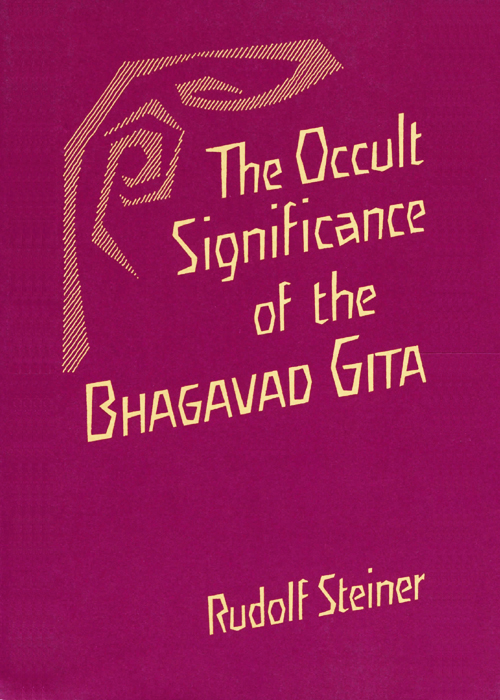


The Occult Significance of the Bhagavad Gita
9 lectures, Helsingfors, May 28 – June 5, 1913 (CW 146)
Steiner reads the old Indian scripture as an occult document. In the midst of a fratricidal battle the lofty Krishna appears in spiritual form to the soldier Arjuna, revealing the mysteries of universal Egohood and the path of yoga. Steiner then describes, out of his spiritual research, how Krishna’s one-sided inspiration of the inner path of the individual was balanced and countered by what Christ brought from outside for all humanity. In impressive pictures he paints the secrets of Krishna’s evolutionary sacrifice, his role in the life and work of Jesus and Christ, and the relevance of his teaching for our own time.
The Occult Significance of the Bhagavad Gita is a translation of Die okkulten Grundlagen der Bhagavad Gita (GA 146), made from shorthand reports unrevised by the lecturer, by George and Mary Adams with further emendations by Doris M. Bugbey. This is the 1968 Anthroposophic Press edition.
About the Author
Rudolf Steiner (1861–1925) was born in the small village of Kraljevec, Austro-Hungarian Empire (now in Croatia), where he grew up. As a young man, he lived in Weimar and Berlin, where he became a well-published scientific, literary, and philosophical scholar, known especially for his work with Goethe’s scientific writings. At the beginning of the twentieth century, he began to develop his early philosophical principles into an approach to systematic research into psychological and spiritual phenomena. Formally beginning his spiritual teaching career under the auspices of the Theosophical Society, Steiner came to use the term Anthroposophy (and spiritual science) for his philosophy, spiritual research, and findings. The influence of Steiner’s multifaceted genius has led to innovative and holistic approaches in medicine, various therapies, philosophy, religious renewal, Waldorf education, education for special needs, threefold economics, biodynamic agriculture, Goethean science, architecture, and the arts of drama, speech, and eurythmy. In 1924, Rudolf Steiner founded the General Anthroposophical Society, which today has branches throughout the world. He died in Dornach, Switzerland.






Reviews
There are no reviews yet