
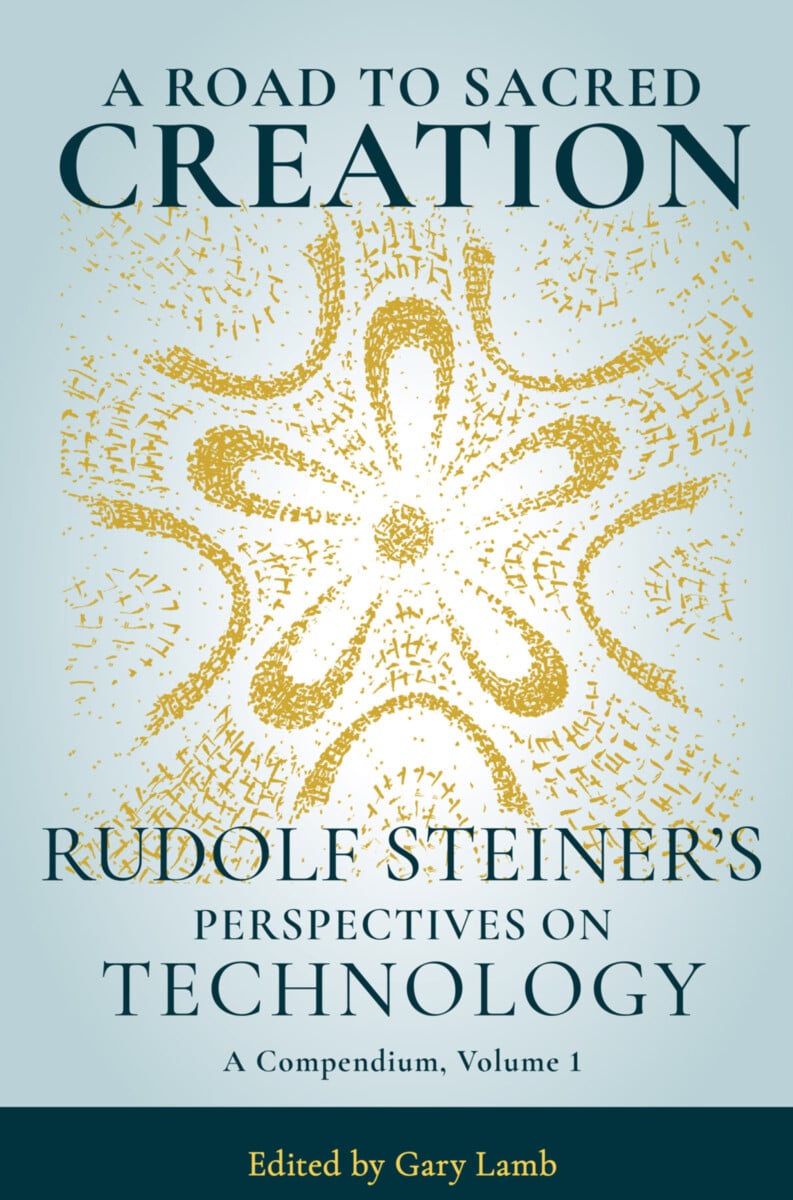

A Road to Sacred Creation: Rudolf Steiner’s Perspectives on Technology
This book is a call to examine the very nature of technology and to develop practices for meeting its many challenges.
“Rudolf Steiner’s perspectives on technology are manifold and prophetic. He not only critiqued the technology of his day, but foretold new forms of technology that would inevitably arise, technologies that would be connected to the makers’ very attitudes of soul, either the good or bad within them—in other words, their deepest motivations. How we, as evolving human beings, approach technology and its development will be instrumental in determining how ultimately human evolution will turn out. Our future as human beings and the future of technology are intimately connected.” —Gary Lamb
Illuminating, compelling, challenging, at times staggering in its breadth, A Road to Sacred Creation is above all the definitive text for gaining a hold on Rudolf Steiner’s nuanced perspectives on technology. Charting both an inner and outer course—part pilgrimage toward greater perception and knowledge, part dramatic, unfolding plot line of the future of humans and machines, the metaphoric “road” of the title is exactly where humanity finds itself today, though the exact route and destination are still to be determined. The map is not yet drawn, but here is a beginning.
Taken together, the relevant concepts, ideas, and insights of Rudolf Steiner, deftly brought into sequence and dialogue as Gary Lamb has done in this book, reveal how the work to arrive at a more spiritually imbued technological future not only involves all domains and fields of spiritual science and anthroposophical work, but has its origins in the very core of our being, fundamentally entwined with our moral progress toward freedom and selfless love.
“What we call ideas are in many ways the lowest hanging fruit of the spiritual world. To enter into that world beyond having ideas requires commitment, preparation, discipline, time, and guidance. Without the practice that these factors support, it is difficult to discern the meaning of and make judgments about what someone might say about the spiritual world. There is ample room for misunderstanding and manipulation of such knowledge. This is one of the reasons that Rudolf Steiner made it very clear that moral development is a necessary prerequisite for any working in spiritual development. It is also one of the reasons that he insisted that Anthroposophy is not a belief system as religions typically are. It is science. Much as is conventional science, it is a process of observation, hypothesis, testing, and reflection in ever-evolving stages. Contemplative experience and what emerges from that contemplation can serve as indicator and guide, a kind of moral compass.” — John Bloom (foreword)
C O N T E N T S:
Preface: How I Came to Edit this Compendium
Editor’s Note: Intention
Introduction
1: The Evolution of Science: From Natural Science to Spiritual Science by Way of Goethe
2: Atoms and Atomic Theories
3: Electricity and the Challenge of Evil
4: Early Twentieth-Century Technology
5: Keely, Strader, and the Development of Etheric Technology
6: Transcending Private Capitalism and Socialism: The Necessity for a Threefold Social Organism
7: Child Development: Waldorf Education and Cultural Freedom in Relation to Technology
8: Ahriman’s Pervasive Influence in the Age of Modern Technology: How to Meet Its Challenge
9: Thinking as a Spiritual Activity
Appendix A: Earth Evolution Illustrations
Appendix B: Publishers Referenced in this Volume
Bibliography
About the Author
Rudolf Steiner (1861–1925) was born in the small village of Kraljevec, Austro-Hungarian Empire (now in Croatia), where he grew up. As a young man, he lived in Weimar and Berlin, where he became a well-published scientific, literary, and philosophical scholar, known especially for his work with Goethe’s scientific writings. At the beginning of the twentieth century, he began to develop his early philosophical principles into an approach to systematic research into psychological and spiritual phenomena. Formally beginning his spiritual teaching career under the auspices of the Theosophical Society, Steiner came to use the term Anthroposophy (and spiritual science) for his philosophy, spiritual research, and findings. The influence of Steiner’s multifaceted genius has led to innovative and holistic approaches in medicine, various therapies, philosophy, religious renewal, Waldorf education, education for special needs, threefold economics, biodynamic agriculture, Goethean science, architecture, and the arts of drama, speech, and eurythmy. In 1924, Rudolf Steiner founded the General Anthroposophical Society, which today has branches throughout the world. He died in Dornach, Switzerland.
Gary Lamb has worked in several occupations over the years, including building construction, farming, carpentry, high school teaching, manufacturing, fundraising, magazine publishing, and more. He cofounded and edited of The Threefold Review, an independent magazine for the study of social issues in the light of Anthroposophy. He is currently co-director of the Center for Social Research (CSR) in Hawthorne Valley, New York. He does research through the Ethical Technology Initiative.
Reviews
There are no reviews yet