
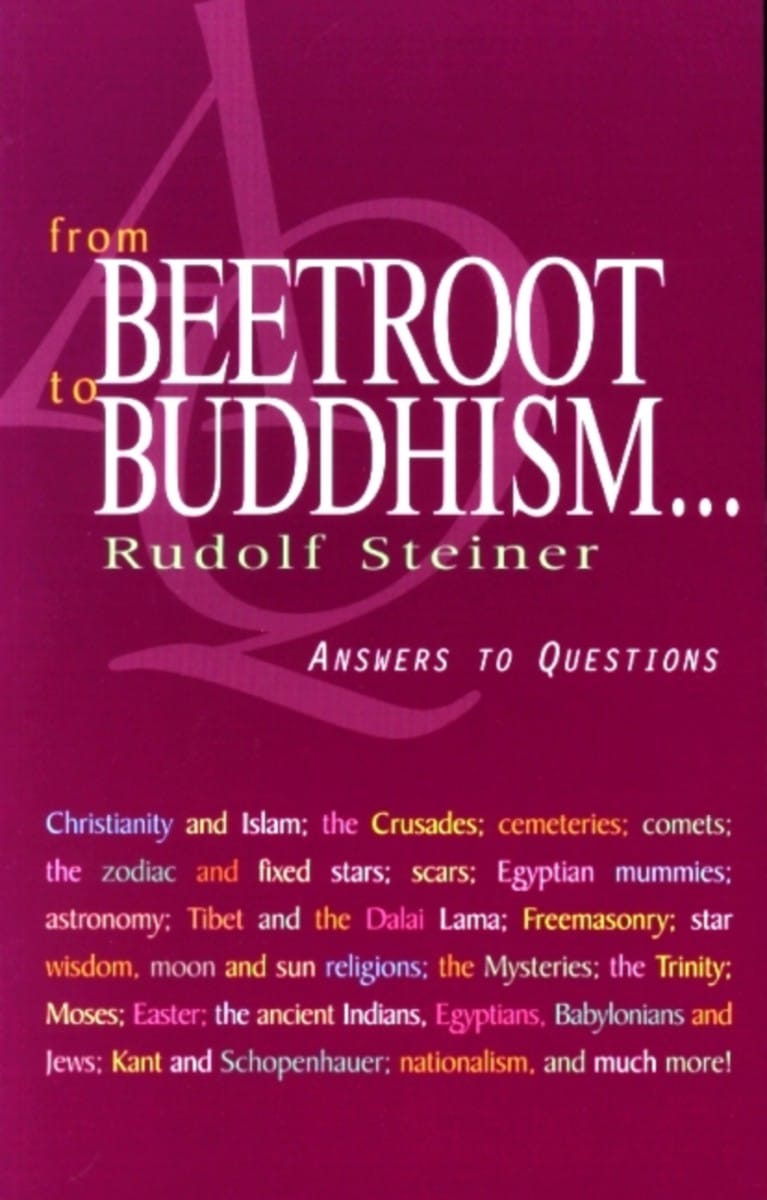

From Beetroot to Buddhism… Answers to Questions
16 discussions, Dornach, March 1 – June 25, 1924 (CW 353)
The remarkable discussions in this volume took place between Rudolf Steiner and workers at the Goetheanum, Switzerland. The varied subject-matter was chosen by his audience at Rudolf Steiner’s instigation. Steiner took their questions and usually gave immediate answers. The astonishing nature of these responses — their insight, knowledge and spiritual depth — is testimony to his outstanding ability as a spiritual initiate and profound thinker. Accessible, entertaining and stimulating, the records of these sessions will be a delight to anybody with an open mind.
In this particular collection, Rudolf Steiner deals with topics ranging from beetroot to Buddhism. He discusses, among other things, Christianity and Islam; the Crusades; cemeteries; comets; the zodiac and fixed stars; scars; Egyptian mummies; astronomy; Tibet and the Dalai Lama; Freemasonry; star wisdom, moon and sun religions; the Mysteries; the Trinity; Moses; Easter; the ancient Indians, Egyptians, Babylonians and Jews; Kant and Schopenhauer, and nationalism.
This volume is a translation from German of Die Geschichte der Menschheit und die Weltanschauungen der Kulturvölker (GA 353).
About the Author
Rudolf Steiner (1861–1925) was born in the small village of Kraljevec, Austro-Hungarian Empire (now in Croatia), where he grew up. As a young man, he lived in Weimar and Berlin, where he became a well-published scientific, literary, and philosophical scholar, known especially for his work with Goethe’s scientific writings. At the beginning of the twentieth century, he began to develop his early philosophical principles into an approach to systematic research into psychological and spiritual phenomena. Formally beginning his spiritual teaching career under the auspices of the Theosophical Society, Steiner came to use the term Anthroposophy (and spiritual science) for his philosophy, spiritual research, and findings. The influence of Steiner’s multifaceted genius has led to innovative and holistic approaches in medicine, various therapies, philosophy, religious renewal, Waldorf education, education for special needs, threefold economics, biodynamic agriculture, Goethean science, architecture, and the arts of drama, speech, and eurythmy. In 1924, Rudolf Steiner founded the General Anthroposophical Society, which today has branches throughout the world. He died in Dornach, Switzerland.





Reviews
There are no reviews yet