

Human and Cosmic Thought
4 lectures, Berlin, January 20–23, 1914 (CW 151)
What convinces us of the truth of a certain point of view? Why do we find it difficult to comprehend viewpoints that differ from our own? What are the inner foundations of our knowledge?
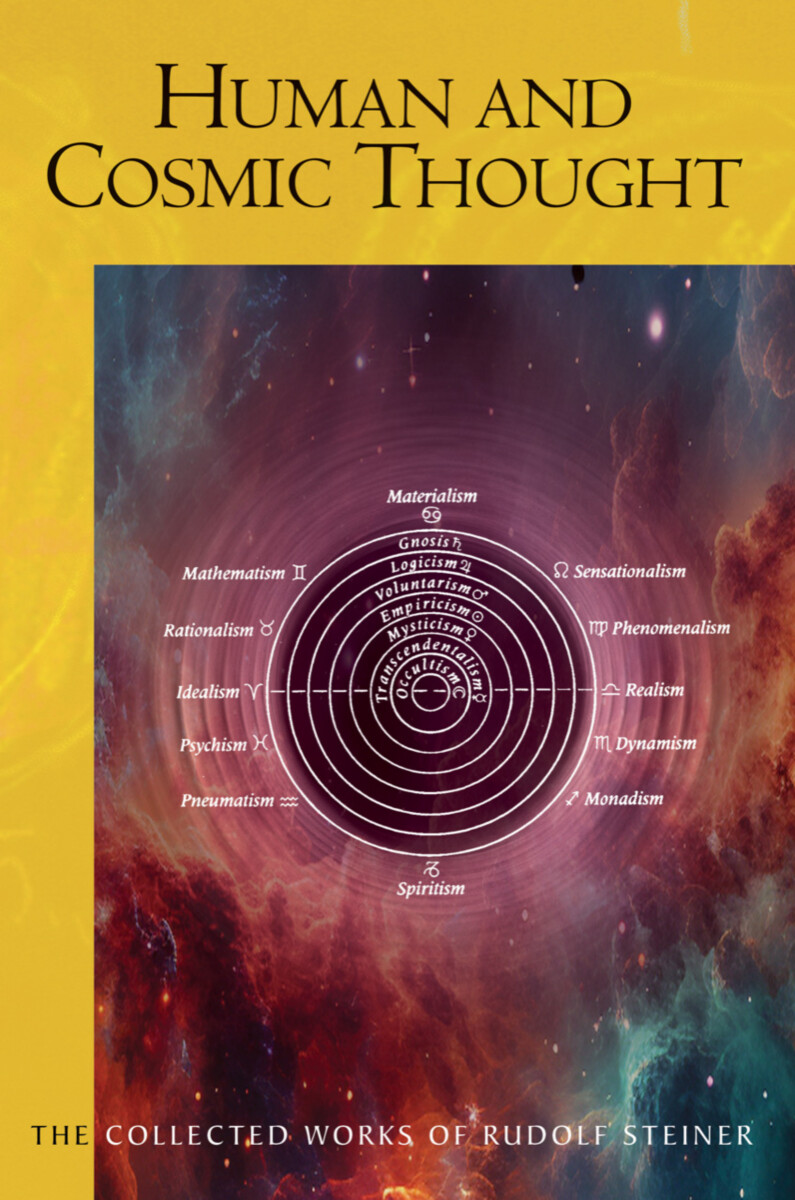
In these concentrated and aphoristic lectures, Steiner speaks of twelve main philosophical standpoints, and the importance of understanding each of them. An appreciation of the variety of possible worldviews not only sharpens and makes more flexible our own powers of thinking, but also helps us to overcome a narrow-minded one-sidedness, promoting tolerance of other people and their opinions.
Steiner goes on to explain how each standpoint is also colored by a particular “soul mood” that influences the way we pursue knowledge. Several philosophers and their works are characterized in this way, shedding light on their contributions to human culture. Through such insight into the true nature of human thinking, we are led to understand the quality of cosmic thought and how, in Steiner’s words, people can be seen as a thought that is thought by the cosmic hierarchies.
Human and Cosmic Thought is a translation from German of Der menschliche und der kosmische Gedanke (GA 151). The lectures were given during the second general meeting of the Anthroposophical Society.
About the Author
Rudolf Steiner (1861–1925) was born in the small village of Kraljevec, Austro-Hungarian Empire (now in Croatia), where he grew up. As a young man, he lived in Weimar and Berlin, where he became a well-published scientific, literary, and philosophical scholar, known especially for his work with Goethe’s scientific writings. At the beginning of the twentieth century, he began to develop his early philosophical principles into an approach to systematic research into psychological and spiritual phenomena. Formally beginning his spiritual teaching career under the auspices of the Theosophical Society, Steiner came to use the term Anthroposophy (and spiritual science) for his philosophy, spiritual research, and findings. The influence of Steiner’s multifaceted genius has led to innovative and holistic approaches in medicine, various therapies, philosophy, religious renewal, Waldorf education, education for special needs, threefold economics, biodynamic agriculture, Goethean science, architecture, and the arts of drama, speech, and eurythmy. In 1924, Rudolf Steiner founded the General Anthroposophical Society, which today has branches throughout the world. He died in Dornach, Switzerland.





Reviews
There are no reviews yet