
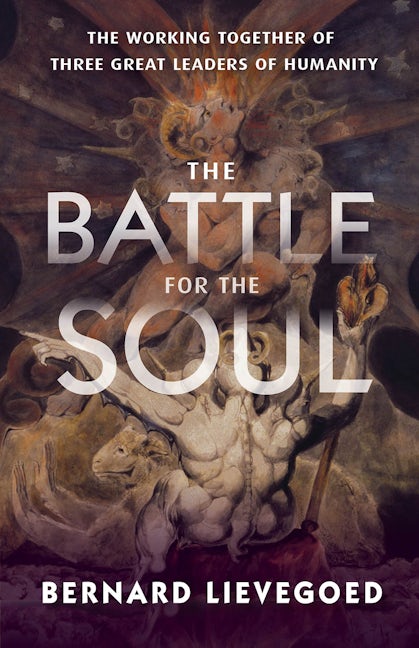

The Battle for the Soul: The Working Together of Three Great Leaders of Humanity
After years of being difficult to obtain, this small book, The Battle for the Soul, is now being brought back into print in the English language.
Dictated in the days preceding his death in late 1992, and published soon thereafter, The Battle for the Soul is the last testament of Bernard Lievegoed and an illuminating companion to his biography, Man with a Mission (F. Lutters, SteinerBooks, 2025).
The themes dealt with here occupied Lievegoed’s inner life for over sixty years and deal profoundly, and presciently, with the soul and spiritual environment through which humanity is now traversing in the twenty-first century.
Lievegoed here shares his inmost thoughts about the spiritual streams in human evolution led, as he explains, by three individualities: Rudolf Steiner, Christian Rosenkreutz, and Manu. He courageously explores their karmic connections and past lives, shedding light on how these spiritual streams are active today. The last chapter is a sobering look at the strategy of the opposing powers and Lievegoed’s intimations about the spiritual challenges of our own time.
About the Author
Bernard Lievegoed (1905–1992) was born in Medan, Sumatra (Dutch East Indies). At nine, his family moved for three years to Rotterdam, and from 1917 to 1922 he attended high school in Java. From 1924 to 1928, Lievegoed studied medicine. He soon became aware of anthroposophic remedial education, which played a significant role in his life. In 1930 in Amsterdam, he completed his medical degree and became a general practitioner. A year later, he established Zonnehuis, a home in Bosch in Duin for children with disabilities. He also founded the Vrije Hogeschool in Driebergen.Soon after, he helped start the Vrije School of Zeist. He studied music therapy, and in 1946 published the book translated into English as Phases of Childhood . In 1954, he established the Dutch Pedagogic Institute for Economics, NPI. He also worked as chair of a government commission on education and continued to teach and write. Lievegoed also wrote a play ( De wadlopers , The Marsh-Flats ) and another book, Man on the Threshold . He continued to write on anthroposophic topics until his death in Zeist.
Reviews
There are no reviews yet